Somewhere in that soft rhythm, Okonkwo stirred in his sleep. His body remained still, but his heartbeat hard against his chest to the rhythm of an ancient drum, one he could hear, but whose drummer remained unseen. With each beat, it felt as though it echoed from deep within the earth, slow and steady.
Then he heard a voice.
It wasn't loud, and it didn't jolt him awake. It was soft and there was something familiar about it, something that counted on his memory to help him recognize it. It spoke like it had been waiting a long time for this moment, patient and certain. It felt otherworldly, like a message carried from somewhere beyond what he could see.
He woke up before dawn. His breath was shallow and his eyes fixed on the low ceiling of his room. The air in the room smelled heavy of damp earth and old wood. Outside, the frogs had gone silent; the darkness seemed to listen as if the whispering voices called out to it too. Okonkwo sat up slowly. Silence filled the room, but the whispering voice remained. Whatever the voice was, it certainly didn't vanish with sleep. It lingered in his thoughts, pressing firmly on the jugular of Okonkwo's faith. He bowed his head and tried to pray. But the words came out hollow, hollow under the crushing weight of unanswered prayers of the past.
Like many African communities, Ununko was beginning to change in troubling ways, and at first, only a handful of people seemed to notice. The religious shift was subtle, almost courteous. There were no more fervent early morning cries by passionate believers, prayer meetings were frequently postponed, and the youth fellowship dissolved temporarily but never came together again. This was the Christianity that the villagers had shared not just for hope but for suffering. It gave meaning to grief and structure to joy. But now, even that was no more. A spiritual crisis was brewing.
The Christian faith that once moved mountains now found itself under siege by a resurgence of traditional beliefs, fueled and energized by the fiery spirit of the youths. Something older than time had begun to stir beneath the surface, like the dead clawing skeletal hands up from the grave, reaching for blood or anything that bore resemblance to life. Okonkwo first sensed this shift not in sermons or declarations, but in conversations. He heard it in the way young men made mention of power, not the moral power of restraint, but the power that brings results now, not leaving everything as rewards in the afterlife. He heard their impatience too.
"Our ancestors were not weak men," a boy had said once at the market. "They knew what worked and what didn't. White man's book doesn't work. It's nothing more than a chronicle of promises. Kingdoms are not built on promises."
Okonkwo did not answer him then, but the boy's words stayed with him. Is this an ordinary and authentic revival? Okonkwo would always ask himself. Whenever the question formed in his mind, another thought followed immediately, whole and uninvited: This is paganism reborn, clothed in modernity's robes, wielding technology's tools, and seducing the minds of the restless and uninformed, deceiving a generation hungry for identity but confused on how to find it. The clarity of that thought unsettled him.
Okonkwo was no stranger to faith. He had been born into it, raised within it, shaped by it in ways that he barely questioned as a child. His mother taught him how to pray before she ever taught him how to speak in proverbs. His father, now long gone, lived between two worlds, the old ways of his people and the church. He respected the church, but his loyalty remained with the traditions he never fully spoke about. There were rituals he never explained, silences he never broke, and now those quiet omissions weighed heavily on Okonkwo’s heart, leaving him with a sense of loss and a yearning to understand the heritage that shaped his father's life. Still, familiarity was not the same as mastery. As a boy, belief came easily to him, almost without effort. But as a man, he had come to understand that faith was not so simple. It demanded something from you, work, sacrifice, and, often, a kind of uncertainty that refused to go away.
He remembered an unanswered prayer years ago. A boy had been sick. Anointed oil had been poured on his head, and fasting on his behalf had been done. Elders of the church had been gathered in prayer, and faith had been sharpened like a blade. But the child had died anyway. None of the explanations felt sufficient. Consolation had been their last resort.
He remembered a prosperity sermon preached to a congregation hungry for food and in need of work. The words sounded appealing. But they floated above their reality, sadly.
He remembered Chukwudi, a young man who had learned faith from the same source and at the same time. Chukwudi had once wept passionately during prayer but later stopped coming to church altogether. When Okonkwo finally asked why, Chukwudi smiled sadly.
"Church teaches patience," he answered. "The world does not wait."
Though these memories did not destroy Okonkwo's faith, they seemed to contradict it. They created a dangerous space where other voices could speak.
When these voices began speaking to Okonkwo, he had first brushed them off as a figment of his restless mind, a mere dream as fleeting as morning mist. But as the days slipped by, the whispers grew louder, weaving through his thoughts like an old fable. The voices did not shout. They reasoned. They came when Okonkwo walked alone on the red-earth paths that ran through the village, past farms and ancestral trees. They came when he sat quietly after prayer, when thoughts softened into reflection. They came in the crucial moments; he was supposed to chew the rudiments of his faith and grow by them.
They spoke of forgotten gods: he could hear what sounded like Amadioha, the roaring thunder; Ala, the great mother; and Ekwensu, the cunning trickster, but the latter was heard most often.
It called to him again, its voice carrying both a quiet longing and an unspoken authority, as though it expected to be heard and obeyed. It seemed to reach for him, asking to be known, to be honored once more.
"Will you not restore what your fathers once held sacred?" it asked. "Do you not see the struggles of your people, hunger, the lack, waiting? Do you not wonder if they could be changed?"
The voice pressed on, steady and persuasive.
"Is it not because you have abandoned what your fathers cherished… what they revere above all else?"
Okonkwo felt the pull of logic. It was not crude temptation. It was historical and cultural. It framed Christianity not as a lie but as an interruption to their culture, challenging the traditional beliefs and practices that had defined their identity for generations.
But Okonkwo was deaf to the murmurs of doubt. He fought back with Scripture, but the verses felt like counters, not conclusions.
The New Yam Festival arrived with unusual anticipation. The air itself seemed to hold its breath. It would shake Okonkwo's world to its core.
The village square, the ground for the sacred event, filled early. Drums sounded much like the ones Okonkwo heard in his head, but with the drum beaters in sight this time.
The drums sounded with rehearsed confidence and purpose. Masquerades walked about on the ground, not as a performance to entertain villagers, but as an invocation. The crowd responded instinctively, their bodies in sudden remembrance of rhythms the mind had never learned.
Okonkwo stood at the edge of the square and watched.
The masquerades kept dancing, those figures wrapped in raffia, their feet stamping against the earth in a rhythmic call to forgotten deities. The crowd wavered with them, chanting praises not to Christ but to the old gods of the land, to the gods that called Okonkwo’s name.
Then the drums softened. That's when he saw him, the one who answered the whisper...
A man draped in crimson stood at the center of the square, his posture relaxed, his authority unchallenged. His presence commanded complete attention. Okonkwo held his breath.
When he spoke, the square fell silent. "We have been asleep for too long," he declared. "The gods of our fathers have returned, whispering to us, seeking to reclaim what was once stolen. Why do you cling to a foreign faith when the spirits of the land call your name?"
Okonkwo's chest tightened to a fierce grip. He knew that voice. Emeka.
Once, Emeka had stood beside him in the choir at St. Mark's Parish. The two had prayed together for revival. Emeka had been sharp, passionate, and uncompromising in devotion. Until his only sister fell ill.
Together, they had prayed for her healing in unity the way the Bible instructed. They had fasted. They had believed.
Afterwards, something shifted in Emeka's heart. He asked questions no one answered well. “If the absolute Divinity of the universe, above all qualities, was omnipotent, how would He allow his only sister to die?”
Now Emeka spoke again, his tone measured. He was as articulate and persuasive as he had once been for the gospel.
"Why cling to a faith that arrived with contempt for the ways of our fathers," Emeka continued, "when the spirits of this land sustained us long before the white man’s ships touched our shores with a message that said our ways were evil?"
The crowd murmured with approval.
Okonkwo did not. But neither could he pretend the questions were pointless nor that it did not shock him how a youth who was once a chorister in St. Paul's Parish was now a priest of something far older, something almost forgotten.
That night, sleep left Okonkwo's eyes. He replayed Emeka's words repeatedly. He didn't reply to them in anger but carefully. The words, now he had thought them through, were not the rant of a rebel. They were the thesis of a thinker.
Had the church lost its way? Okonkwo wondered. Had it failed? Were the people of Ununko searching in vain for a comfort that had long slipped through their fingers? Were they searching for something they no longer found in Christianity?
Then he thought in another direction: what if Christianity had not failed, but had been poorly embodied? What if the problem was not the message, but the messenger and its version of the good news?
That night, as the darkness deepened, the whispers returned, bolder now.
"You see," they said. "This change is not abandoned. This is the restoration of your ancestor’s heritage."
Okonkwo rose before dawn and stepped outside. The village lay quiet, but the air felt alert, as though awaiting a response.
He clutched his Bible, not as a weapon of warfare but as an anchor in a turbulent moment.
Then another voice joined the chorus, firm and unwavering.
The voice did not argue. It did not flatter. And it did not shout.
"Do not be afraid," it said quietly. "I am with you, always."
The words did not erase Okonkwo's doubt. They steadied him within it and helped his turbulent heart find its calm.
Above all, it reminded him whose voice it was, the One who conquered death. It was His immortal voice echoing through the corridors of time and into ages yet to come. The battle was not lost or over. This was especially true when the voice of the Holy One declared otherwise.
In the following days, Ununko revealed how far it had drifted away from the faith.
A woman at the market openly condemned prayer, muttering about how it offended the earth and the gods of their ancestors. A shrine appeared near a footpath where a church sign once stood. Youths laughed openly at hymns. They called them songs of the enslavers.
As Okonkwo walked through Ununko, it felt both strange and familiar. Faith had not vanished, not really. But it had clearly lost the authority it once firmly held over the land. He realized then that neutrality was no longer possible.
And for that he sought out Emeka.
The two men met at dusk, away from the square. Emeka greeted him warmly, not looking suspicious.
"I wondered when you would come," Emeka said.
"You have changed altars," Okonkwo replied quietly.
"Why cling to an altar that holds no answers?" Emeka smiled.
They spoke for a long time. And in all that time Emeka did not mock Christ. He only spoke of justice, relevance, and power. He spoke of faith that promised heaven while people suffered on earth. But no matter how reasonable he sounded, Okonkwo could still hear the begrudging pain of his sister’s death.
"You ask people to wait," Emeka said. "The spirits act."
Okonkwo had no easy answers. Neither could he despise Emeka for asking his questions.
When they parted, neither of them felt victorious.
That evening, Okonkwo walked home alone. The last light of day bruised the sky above, and the red earth beneath his feet still held the warmth of the sun. Behind him, the square had long emptied, but the air felt far from settled. The whispers now followed him more closely, impatient and stripped of their earlier subtlety, as if he had confronted and defied them, leaving them no longer able to hide.
"You stand against your own people now," they suggested.
"You resist what is rising. Why struggle against what feels inevitable?"
He refused to argue with the whispers. He did not rehearse rebuttals or gather clever words. He answered not with argument but with obedience, with every step taken forward when retreating would have been easier. With a silence that refused to surrender.
He did not know what Ununko would become, or whether the church would endure or dissolve quietly into memory. He did not know whether his voice would steady others or isolate him further.
But he knew the truth: the future of faith does not belong to the loudest gods, nor to the drums that gather the largest crowds. It belongs to those who are willing to speak when silence feels safest, when neutrality promises comfort, when the tide insists on compliance.
Before the first light of dawn, in the fragile hush that comes before birds dare to sing, he rose again. Sleep had been shallow, but his resolve had not thinned. He washed and dressed and reached for his Bible, not as a talisman against fear, but as a covenant he had rekindled.
The whispers hovered still, though they had grown sharper.
"This land remembers," they pressed.
"It remembers what your fathers knew. What you're obligated to carry on."
Okonkwo stepped outside into the dim blue of morning. Mist clung low to the earth, and the village seemed suspended between yesterday and whatever would follow. He did not reach for a sword. He did not summon anger. Instead, he summoned truth, a truth that was quiet, unadorned, and costly.
"When the pantheon whispers," he murmured to himself, "the faithful must answer, not in silence, not in allegiance, but in the voice of the eternal Word."
The words did not thunder. They steadied his turbulent mind.
As he walked through Ununko, the shifting tide revealed itself in fragments. Two elders spoke in hushed tones about the old way returning, rising like a phoenix from neglect. At the edge of the village, young men gathered near a newly marked shrine, their laughter bold, their confidence borrowed from something ancient. The church doors stood open, but fewer worshipers entered.
Okonkwo felt the weight of it not as outrage but as a burden. It did not flare within him like anger; it settled instead like responsibility. The struggle ahead would not be won in a single sermon delivered with trembling passion, nor would it be lost in a single festival filled with drums and ancestral chants. It would unfold slowly, almost invisibly. It would be lived in conversations held beneath mango trees, in pauses before agreement, in the quiet courage to disagree when agreement would be easier. It would be fought in the small, unknown household decisions that shape a people long before history named them.
The whispers had not ceased. They lingered at the edges of his thoughts, patient as ever, reshaping their arguments, refining their tone. Perhaps they would never fall silent. Perhaps every generation that would follow would hear them in some form, and he would never cease to answer. Not loudly or theatrically. He would answer faithfully.
He walked through the village with a quiet resolve, even though uncertainty hovered. He understood now that faith, once truly chosen, could not remain hidden. It was not something to be tucked away like an old inheritance, remembered in silence and left in the past. It had to be lived, shown where it was dismissed, spoken about where it was questioned, and held onto without fear or bitterness. To be quiet while other voices grew louder was not an act of faith.
The thought settled firmly in him: faith that goes silent does not endure. It fades, becoming nothing more than a distant memory, something preserved in stories with no form of life.
It was in that delicate space between what was rising and what still stood on its ground that Okonkwo made his decision. Not because he was sure his words would change anything, but because staying silent now felt heavier than speaking. In the end, obedience was the only thing he could hold on to.
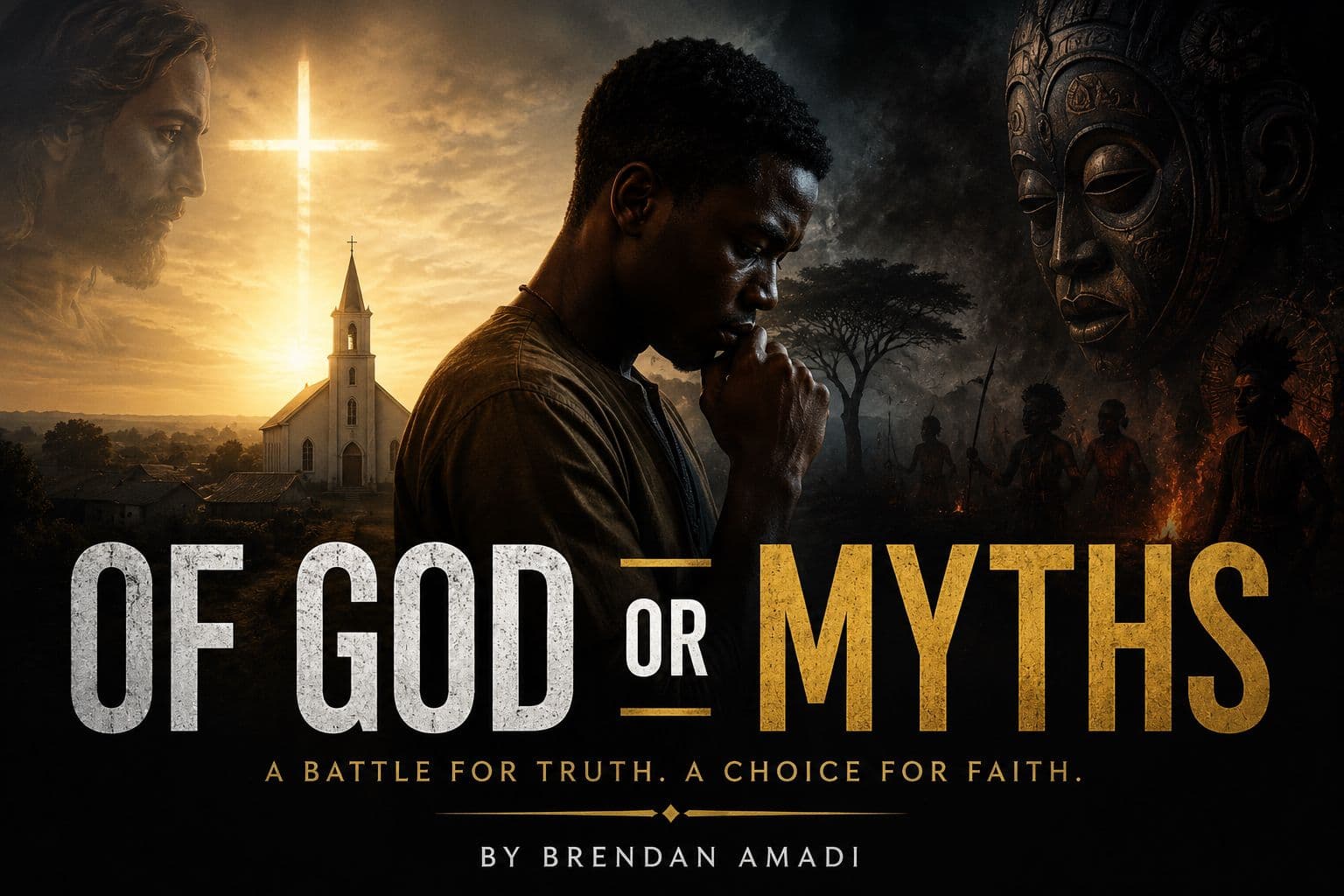
Of God or myths
A profound narrative exploring the spiritual crisis in the village of Ununko as traditional beliefs clash with the Christian faith. It follows Okonkwo's quiet but steadfast resolve against the whispering gods of the past.
By Amadi BrendanJune 15, 202512 min read300K views
Media
About the Author
Amadi Brendan
This author contributes inspiring stories and spiritual content to our community.
View all stories →Loading related stories...